Category Archives: Fats
Omega 3 FAQ: Sorting the Facts from the Fiction
This is another guest post from my talented intern and nutrition student Coco Noel.
You’ve heard enough about the elusive “Omega 3s” to know they’re not a Christian rock band. But you’re still unclear:
Should you buy fish oil? Opt for the flaxseed granola? Atlantic or Alaskan salmon?
But what about mercury? Eat omega 3-enriched eggs? How about walnuts? Is the room spinning yet?
Before your confusion leads you to seriously consider the merits of eating green eggs and ham (hint: there are none), I’ll explain the basics of essential omega fatty acids, why they matter, and outline simple ways you can utilize them for good health.
What are they?
Both omega 3 and omega 6 are essential fatty acids, which means your body can’t make them on its own, so you have to get them from food.
Omega 3s are anti-inflammatory, slow down cell growth, and have anticoagulant properties.
There are two main types of omega 3s:
DHA and EPA are found primarily in fish and shellfish.
ALA is found mainly in plant sources (walnuts, flax and chia seeds), and doesn’t offer the potent health effects as DHA and EPA.
Omega 6s can increase inflammation, encourage cell growth, and aid in blood clotting.
Our bodies perform best when we take in a balance of omega 6 to omega 3. The ideal ratio falls somewhere between 1:1 to 3:1 of omega 6:omega 3. Unfortunately, the average American is taking in a ratio of about 20:1. This creates a continual state of inflammation in the body – prime conditions for chronic disease, cancer growth, and premature aging.
Fish Oil Supplements Aren’t the Answer
While ingesting large amounts of omega 3-rich fish oil supplements may seem like the obvious solution, it’s not. Omega 3s are very fragile and the extraction process almost always subjects them to high temperatures, processing, and chemical solvents to take away that fishy odor…you don’t really think that strawberry-flavored fish oil comes from a strawberry-flavored fish, do you?
It’s estimated that 25-50% of fish oil supplements are rancid before you even open the bottle. This means that once that oxidized fish oil is in your body, it’s going to encourage a state of inflammation –the opposite of what you want!
Recent research suggests that the best and safest way to achieve a healthy ratio of omega 6:3 isn’t by trying “even out” the balance by ingesting copious amounts of omega 3s – even if the supplement is of good quality. Rather, it’s recommended that you simply adjust your diet so that you’re taking in fewer omega 6s in favor of more omega 3s.
Eat Your Way to a Perfect Balance
- Eat seafood!
- Between 2-4 times per week,
- Reach for sustainable, omega 3-rich seafood such as:
Wild Alaskan salmon (avoid farm-raised salmon, which includes those labeled Atlantic or pink)
Arctic char
Atlantic mackerel
Sardines
Sablefish/black cod
Anchovies
Oysters
Rainbow trout
Mussels
Halibut
Albacore tuna—contains notably higher levels of omega 3 than chunk light (limit to 6 ounces per week)
Find a great quality online source for seafood here
The benefits of eating fish far outweigh any risks. While mercury toxicity is often touted as a reason to shy away from seafood, most ocean fish is very high in selenium, which is protective against mercury.
- Choose grass fed beef and dairy
While all cows have similar levels of omega 6s, milk, butter and meat from grass fed cows are higher in omega 3s than cows raised on grain. In fact, grass is full of the omega 3 fatty acid ALA, which grass fed cows convert to the higher-quality DHA and EPA. Amazing!!!
A great source of grass fed beef can be found here
- Eat Pastured chickens and eggs
An article from Mother Earth News found that eggs from pastured chickens – that is, those gals who are roaming the countryside eating seeds, bugs and grasses – contain two times more omega 3 than eggs from factory farmed chickens.
A good source of soy free pastured eggs online can be found here:
Read Caitlin’s article on the need for purchasing soy free eggs here:
“Sometimes” Foods
- Limit nuts.
Walnuts contain 10 times more omega 6 than omega 3. Almonds provide almost no omega 3 whatsoever. Because the omega 6 fats in nuts are packaged in a whole food with other nutrients, like selenium, fiber and vitamin E, which can prevent rancidity, it isn’t necessary to avoid them altogether. But moderation is key; they are fine snacks, but should not be counted on to supply a significant amount of protein or calories. - Flax and chia seeds are plant sources of omega 3.
These are fine to include in your diet, but our bodies cannot efficiently convert the ALA to DHA/EPA. - Keep flax refrigerated and buy the whole seed; if you want to grind it, do it yourself with a blender or food processor to decrease oxidation.
Run in the Other Direction
- Reconsider chicken as your main protein source: Eat dark meat poultry in moderation because this is where the omega 6 is concentrated.
- Avoid industrialized seed oils. Soybean, cottonseed, corn and anything labeled “vegetable” oils are very high in omega 6. At restaurants, request that your food be cooked in butter than rather vegetable oil.
- Avoid isolating the omega 6 in the form of nut oil, which is prone to oxidation and doesn’t come packed with protective nutrients that are found in whole nuts. Coconut oil, ghee, butter, and olive oil are better options.
Note: A cold-pressed fermented cod liver oil offers nominal amounts of omega 3, but is packaged as a multi-nutrient whole food and isn’t plagued by the same over-processing and striping of nutrients as fish oils.
-by Coco Noel
Be sure to check out Coco’s facebook page
Share this article with your friends who may be confused about omega’s 3s!
For more info about Omega 3 read my article about Fish Oil Do’s and Don’ts.
Find the only Fish oil I recommend here:
SOURCES:
http://www.ncbi.nlm.nih.gov/pubmed/16500874
http://www.motherearthnews.com/Real-Food/2007-10-01/Tests-Reveal-Healthier-Eggs.aspx#axzz2PHhOwsin
Fish Oil: Do’s and Don’ts
Fish Oil has been touted as a miracle anti-inflammatory in western and alternative circles for many years and it can have many health benefits if it is pure, fresh and from a good source.
I think people should try to get your omega 3′s from eating wild fish from a great source a couple times a week before considering supplementation. Wild fish have more nutrient density than fish oil alone including important co-factors like selenium, Vitamin D, iron and magnesium.
It is really important to focus on the highest quality when picking a fish or cod liver oil because these oils can do more harm than good if you don’t shop carefully.
Tips to Remember About Fish Oil or Cod Liver Oil:
Do’s:
- Buy one that is cold processed to prevent undoing any anti-inflammatory benefits.
- Buy in small batches (not like a Costco brand because it will spoil before you finish it).
- Keep your dose to a reasonable levels of no more that one or two grams per day.
- With fish oil, check that you are actually getting a good amount of EPA and DHA (about 500 mg of each per day).
- Always take fat soluble vitamins A and D together because they are synergistic. Make sure the ratio is balanced the way it is in cod liver oil.
- Look for a manufacture date to help you determine freshness: such as on this cod liver oil.
- Remember that the Vitamin A in CLO can help protect the polyunsaturates from oxidation.
- Get a CLO that is fermented because it makes the vitamins more bio-available for the body.
- Decrease omega-6 in the diet because omega-3 supplementation cannot make up for grain fed meat and industrial seed oil consumption.
- Do smell your oil and if it smells like a rotten fish it is not fresh. Instead, fish oil capsules should smell like the ocean.
- Look for a fish oil that has Vitamin K2 which is helpful in blood clotting, heart disease protection, healthy skin, strong bones, proper brain function, proper growth/ development and cancer prevention. Vitamin K2 is available in cod liver oil.
Don’ts
- Don’t store your fish or cod liver oil in a warm place or outside the fridge.
- Don’t buy fish oil or Cod liver oil that comes in a clear bottle.
- Don’t take fish oil or Cod liver oil away from a fatty meal because the fat soluble vitamins A, D and K will be absorbed.
- Don’t be afraid of taking vitamin A as long as it is in proper balance with Vitamin D like in this CLO
- Don’t buy farmed fish that have unnatural amounts of contaminants and antibiotics in their food. Farmed fish are fed gmo corn and soy and will have an unhealthy balance of omega-3/6 that will be passed on to you.
- Don’t buy a fish oil without a Certificate of Analysis, which screens for levels of contamination of PCB’s and heavy metals.
- Don’t buy GMO salmon (if approved possibly by Feb 2013) because of unknown changes to our DNA from eating modified food.
- Don’t convince yourself that taking fish or CLO can make up for a standard American diet.
- Don’t overlook the other ingredients that are used as fillers such as corn, soy or canola oils that are highly inflammatory.
- Don’t forget to look for a company that is using sustainable methods of fish harvesting. Approval from the Marine Stewardship Council is a good sign.
Which is one is best?
The only brand of fish oil that I think is properly prepared is the cod liver oil from Green Pastures. It is cold pressed and from wild fish. This CLO is more like a food so it does not have the exact measurements of DHA and EPA on the label. That is because there are so many compounds in food that work together and we do not understand them enough to separate out. That is why it is important to eat whole foods as much as possible. That being said, I am not sure many people would actually eat cod liver if was not made into supplement form.
Order the best cod liver oil on the market, especially if you are not eating fish a few times a week.
Many of my clients have taken this brand and they reported less cold’s, improved energy and better skin. Let me know how it works for you!
Are there any criteria for choosing a good fish oil supplement that I have overlooked?
Sources:
http://www.westonaprice.org/faq/faq-cod-liver-oil
http://chriskresser.com/the-definitive-fish-oil-buyers-guide
Which Fats and Oils Are Healthy?
These seems to be a lot of confusion about which fats are healthy to use in the kitchen. It can be really simple if you ask yourself these three questions:

How to choose fats and oils:
Ask yourself these simple questions:
- Is this fat minimally processed and/or can I make it in my own kitchen?
- Was this food eaten by my ancestors?
- Does this fat or oil taste good by itself?
Which fats and oils to eat:
- Coconut oil
- Organic Grass fed butter
- Ghee/ clarified butter
- Grass fed beef tallow
- Pastured Duck fat/ chicken fat
- Lard From pastured pigs
- Organic Pastured Soy-free Eggs
- Palm oil
- Avocados
Eat but don’t heat:
- Cold pressed olive oil
- Cold pressed sesame oil
- Cold pressed walnut oil
- Organic Macadamia Oil
- Avocado Oil
- Flax oil (never heat!!)
- Nut and seeds
Which to avoid:
- Corn oil
- Rice Bran oil
- Canola oil
- Soybean oil
- Cottonseed oil
- Margarine
- Safflower oil
- Grape seed oil
- Most commercial salad dressing-read the lable
- Low fat butter spreads/spritzers
- Cooking Spray’s-Pam
- Blended olive oils-used in many restaurants to cut costs
Reasons to avoid factory fats:
- Oxidized during high heat processing, which creates pro-aging free radicals
- They increase inflammation and cardiovascular disease risk
- Made are from genetically modified seeds which have never been tested but deemed safe by Monsanto
- Toxic chemicals and detergents are used to get the oil out of the seeds
- Bleached and deodorized to make the product palatable
- Increase gut irritation and permeability opening the door for autoimmune diseases
- Increase weight gain because they have appetite stimulating compounds
Look here for a great chart on fats and oils:
balancedbites.com/useful-guides
Sources:
How to Make Ghee In The Crock-Pot
Education Moment:
I never used much ghee before because it is pretty pricey at over $10 for a 13 oz jar and that seemed out of my budget. Grass Fed Butter, which is used to make ghee, is rich in vitamin A and D but it also has a milk protein called casein that causes a reaction in some people. Casein has been shown to be inflammatory in many studies but those are usually done with conventional feed- lot antibiotic filled milk, which is not a fair comparison with raw grass-fed dairy.
It is a good idea to eliminate dairy for 3-4 weeks to see if it is causing you digestive distress, sinus problems, rashes or weight gain. I tried this recently and I don’t think grass fed butter is a problem for me but each person has to test their own tolerance. Besides the benefit of getting rid of the casein, ghee tastes amazing! Ghee is a beneficial saturated fat that is shelf stable and safe for use at higher heats. Here is how the magic happens..
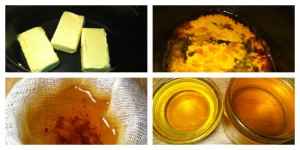
1. Place three or four 8oz packages of grass fed butter such as Kerrygold ($2.79 each at trader Joe’s) into your crock pot.
2. Set it on low for 2.5 hours.
3. Put a cheesecloth over a glass container and strain the cooked butter through it.You should end up with almost as much product as you started out with. There should only be a small amount of milk solids left that can be discarded.
4. Cover and keep in the cupboard or refrigerator for future delicious recipes. Ghee can be used anywhere butter would normally be used. It has a sweet flavor that is wonderful change of pace.
If this seems like too much trouble you can buy grass fed organic ghee here.