Category Archives: Fermentation
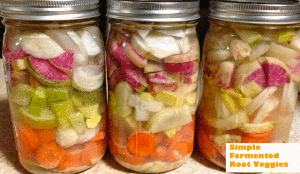
Simple Recipe: Fermented Radishes, Carrots and Turnips
I have made sauerkraut a few times and it turned out pretty well. My sister taught me this easy way of fermenting vegetables which helps add variety. This method can also be helpful if you have an excess of vegetables at certain times of the year that you need to preserve. My little sister is very handy in the kitchen and is always showing me something new and interesting. You can read more about her Paleo weight loss success story here and see her Paleo home tour here.
Several Great Benefits of Fermented Vegetables:
- Lacto-fermentation uses Lactic acid as a natural preservative that inhibits bacteria found on vegetables and fruit, This traditional method differs from the vinegar or high heat pasteurization commonly used today for preservation.
- The proliferation of lactobacilli in fermented vegetables enhances their digestibility and increases vitamin level drammatically.
- These beneficial organisms produce numerous helpful enzymes as well as antibiotic and anti-carcinogenic substances.
- The main by-product of fermented veggies is lactic acid which promotes the growth of healthy flora in the intestine.
- Lacto-fermented vegetable condiments will keep for many months in cold storage.
- Fermented veggies have more bio-available probiotics and a greater variety of strains than the ones available in pill form.
- Every mouthful of fermented foods you consume contains trillions of beneficial live bacteria which can help balance the immune system, reduce cravings, heal the gut lining, and improve digestion.
Literally, one serving of vegetables is equal to an entire bottle of a high potency probiotic! So clearly, you’re far better off using fermented foods.- Dr. Mercola
Ingredients:
1 bunch of colorful radishes, ends chopped off and cut into quarters
1 large of Daikon radish, sliced
1 bunch of carrots, sliced
1 cup of turnips, peeled and chopped
6 cloves garlic, crushed
2 teaspoon mustard powder
3 bay leaf
2 teaspoon coriander
3″ ginger, peeled and diced
3/4 cup whey, dripped out from plain yogurt or Kefir with active cultures, or from raw cheesemaking ( you can use a store bought organic yogurt and just strain off the liquid at the top)
1/2 red or white onion, sliced thinly
1 Tbsp Real Salt
1 cup+ extra water (approximately) for each jar
Note: For dairy allergy: Add a couple Tbsp of leftover unpasteurized sauerkraut juice as a starter in each jar.
Directions:
It is important to use the best quality organic vegetables, sea salt and filtered or pure water for lacto-fermentation.
Put all ingredients (except salt and water) in a clean wide-mouth quart size jar.
Dissolve the salt in a cup of water — if necessary heat it and then cool it. Pour over all ingredients. Add additional water to cover all ingredients, but keeping below 1” from jar rim. Use a clean regular mouth jar lid to weight down ingredients below surface of liquid (otherwise they like to float up to the top). Cover jar tightly.
Let ferment at room temperature for 3 to 5 days. Taste to see if you like the texture and taste. Skim off any mold that accumulates on the surface. When you feel it is done, transfer to the refrigerator or cool storage.
Yield: 3 quarts jars. Adapted from Gnowflins
Awesome Sources for Fermentation Basics and Beyond:
This book is by Alex Lewin who breaks down the simple art of fermentation with amazing photos and step by step guides.
Also this book is a must have for every real foodie. It is Sally Fallon’s bible for fermentation and everything traditional foods:
Sources:
http://articles.mercola.com/sites/articles/archive/2012/05/12/dr-campbell-mcbride-on-gaps.aspx
http://www.westonaprice.org/food-features/lacto-fermentation
Easy Recipe for Raw Sauerkraut
![]() |
| The class in full chop |
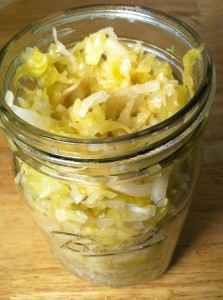
Recently I attended a raw sauerkraut class at my friend Sarah’s house. She is an expert on making raw kraut. I was so surprised at how easy it was. I have since made two yummy batches at home. You don’t need any special tools, just a jar and some cabbage. This food is so beneficial and so cheap to make. I hope this post inspires you to make your own kraut.
![]() |
| My friend Sarah Eddison, NC teaching about the benefits of Raw Kraut |
Benefits of Raw Sauerkraut:
- Boosts the immune systems to fight the common cold and flu
- Packed with vitamins and minerals such as calcium, Vitamins K1, C and beta-carotene
- Raw sauerkraut can be helpful in reducing risk of some cancers because it has unique phytochemicals created during fermentation
- In a recent study the women who immigrated from Poland Americanized their diets and stopped eating as much of this super food which may have increased their rates of breast cancer
- Supports a balance of beneficial bacteria in your gastrointestinal tract
- Helps Inhibit pathogenic organisms including E.coli, salmonella and unhealthy overgrowth of candida
- Fermentation of sulphur rich kraut creates antioxidants (glutathione and superoxide dismustase) that lower free radicals
- Helps to break down hard-to-digest lactose from milk to the more easily digested lactic acid
- Fermented foods facilitate the breakdown and assimilation of proteins
- It helps neutralize the anti-nutrients found in many foods including the phytic acid in grains
- Raw kraut can reduce inflammation associated with many bowel conditions
- Probiotics from the cabbage can also help increase transit time and reduce diarrhea symptoms
- Can improve symptoms of heartburn and GERD by taking just a tablespoon with meals
Recipe:
![]() |
| Me and my childhood friend Julia with our homemade kra |
Ingredients:
1 head of raw organic cabbage
(keep one large outer leaf on the side)
1 cup of shredded red cabbage
1 tbsp Dulse Flakes
1 tbsp chopped garlic
1 tbsp Sea Salt
1 bunch fresh parsley or cilantro
1 clean 32 oz jar with lid
1/2 cup shredded carrots
Chop the cabbage into very thin strips. You can also use the grater attachment on your food processor. This appliance will speed up the process quite a bit. Put all the ingredients into a large mixing bowl. Vigorously massage cabbage with hands for 10 minutes until the water is coming out and it is translucent. When you can squeeze the cabbage and lots of water is dripping out, it is time to grab your jar. Tightly pack all of the cabbage into the jar until the liquid is 1 inch above the top of the cabbage. Now add the outer leaf on the top like a cover. Make sure the water is above all the cabbage. Pour any excess cabbage juice from the bowl into the jar. Now cover with a lid and put in a cool dry cabinet for 1-4 weeks. When you feel like it is ready, remove outer leaf cover and taste. If it is not soft enough you can just put it back away for more fermenting. When you feel it has fermented enough put it in the refrigerator to stop the process.
If you are too busy to make you own try these great brands. I eat a tablespoon of Sauerkraut with most meals to improve my digestion. It is great on meats and poultry as a garnish. Try adding this super food to your menu today and you will wonder how you lived without it.
Easy Recipe for Raw Sauerkraut
![]() |
| The class in full chop |
Recently I attended a raw sauerkraut class at my friend Sarah’s house. She is an expert on making raw kraut. I was so surprised at how easy it was. I have since made two yummy batches at home. You don’t need any special tools, just a jar and some cabbage. This food is so beneficial and so cheap to make. I hope this post inspires you to make your own kraut.
| My friend Sarah Eddison, NC teaching about the benefits of Raw Kraut |
Benefits of Raw Sauerkraut:
- Boosts the immune systems to fight the common cold and flu
- Packed with vitamins and minerals such as calcium, Vitamins K1, C and beta-carotene
- Raw sauerkraut can be helpful in reducing risk of some cancers because it has unique phytochemicals called isothiocynates and sulphorane created during fermentation
- In a recent study the women who immigrated from Poland Americanized their diets and stopped eating as much of this super food which may have increased their rates of breast cancer
- Supports a balance of beneficial bacteria in your gastrointestinal tract
- Helps Inhibit pathogenic organisms including E.coli, salmonella and unhealthy overgrowth of candida
- Fermentation of sulphur rich kraut creates antioxidants (glutathione and superoxide dismustase) that lower free radicals
- Helps to break down hard-to-digest lactose from milk to the more easily digested lactic acid
- Fermented foods facilitate the breakdown and assimilation of proteins
- It helps neutralize the anti-nutrients found in many foods including the phytic acid in grains
- Raw kraut can reduce inflammation associated with many bowel conditions
- Probiotics from the cabbage can also help increase transit time and reduce diarrhea symptoms
- Can improve symptoms of heartburn and GERD by taking just a tablespoon with meals
Recipe:
| Me and my childhood friend Julia with our homemade kraut |
Ingredients:
1/2 cup shredded carrots
Directions:
If you are too busy to make you own try Bubbies or Farmhouse Culture Brands – both are available at Whole Foods. I eat a tablespoon with most meals to improve my digestion. It is great on meats and poultry as a garnish. Try adding this super food to your menu today and you will wonder how you lived without it.
Sources: wapf.org, www.livestrong.com, Sauerkraut.com